Wednesday, July 11, 2012
12 Napapakinabangang Origami
Noong bata ako, isa sa mga naging laruan ko ay ang mga eroplanong ako mismo at mga kalaro ko ang gumawa mula sa papel. Ito ang unang enkwentro ko sa origami bagamat hindi ko pa alam ang pangalan nito noon.
Para sa maraming mga tao, ang origami ay isa lamang nakaka aliw na libangan. Pero kung tutuusin ay may mga pagkakataon na napapakinabangan talaga ang origami.
Eto ang 12 sa mga origami na para sa akin ay maaring pakinabangan kapag kinailangan ng pagkakataon:
1. Tasa
2. pitaka
3. kahon
4. kwadradong bowl
5. bowl ng kendi
6. kahon na pahaba
7. basket
8. envelop
9. buslo
10. photo frame
11. lalagyan ng buto ng halaman
12. bookmark


Thursday, July 5, 2012
Coix lacryma-jacobi l.
I used to think that the plant I knew as "katigbi" was just a worthless weed.

However, at the "Makina Saka Expo" of the Department of Agriculture (DA) which was held at the World Trade Center last July 4-7, 2012, I learned that katigbi - its seed- is actually edible and has even been identified by the DA as a potential crop that can help strengthen our food security.
Coix lacryma-jacobi l is the scientific name of katigbi. One of its name in english is Job's tears which is actually the meaning of lacryma jacobi. In some areas of the country though, it is more known as "adlai".
The milled seeds of "adlai" has a glutinous corn like taste that has a lot of potential use even in fine cuisines. In fact, people in other countries like China and Vietnam already utilize this as food. I was able to taste it steamed and I thought it was really nice.
I hope the DA succeeds in promoting the propagation and acceptance of this crop locally.


However, at the "Makina Saka Expo" of the Department of Agriculture (DA) which was held at the World Trade Center last July 4-7, 2012, I learned that katigbi - its seed- is actually edible and has even been identified by the DA as a potential crop that can help strengthen our food security.
Coix lacryma-jacobi l is the scientific name of katigbi. One of its name in english is Job's tears which is actually the meaning of lacryma jacobi. In some areas of the country though, it is more known as "adlai".
The milled seeds of "adlai" has a glutinous corn like taste that has a lot of potential use even in fine cuisines. In fact, people in other countries like China and Vietnam already utilize this as food. I was able to taste it steamed and I thought it was really nice.
I hope the DA succeeds in promoting the propagation and acceptance of this crop locally.

Tuesday, April 24, 2012
Sa Exotic Restaurant, Pakil, Laguna

Kahit maraming taon na mula nang magbukas ng pintuan ang restaurant na ang pangalan ay EXOTIC sa Pakil, Laguna, kelan lang ako nakapunta dito.
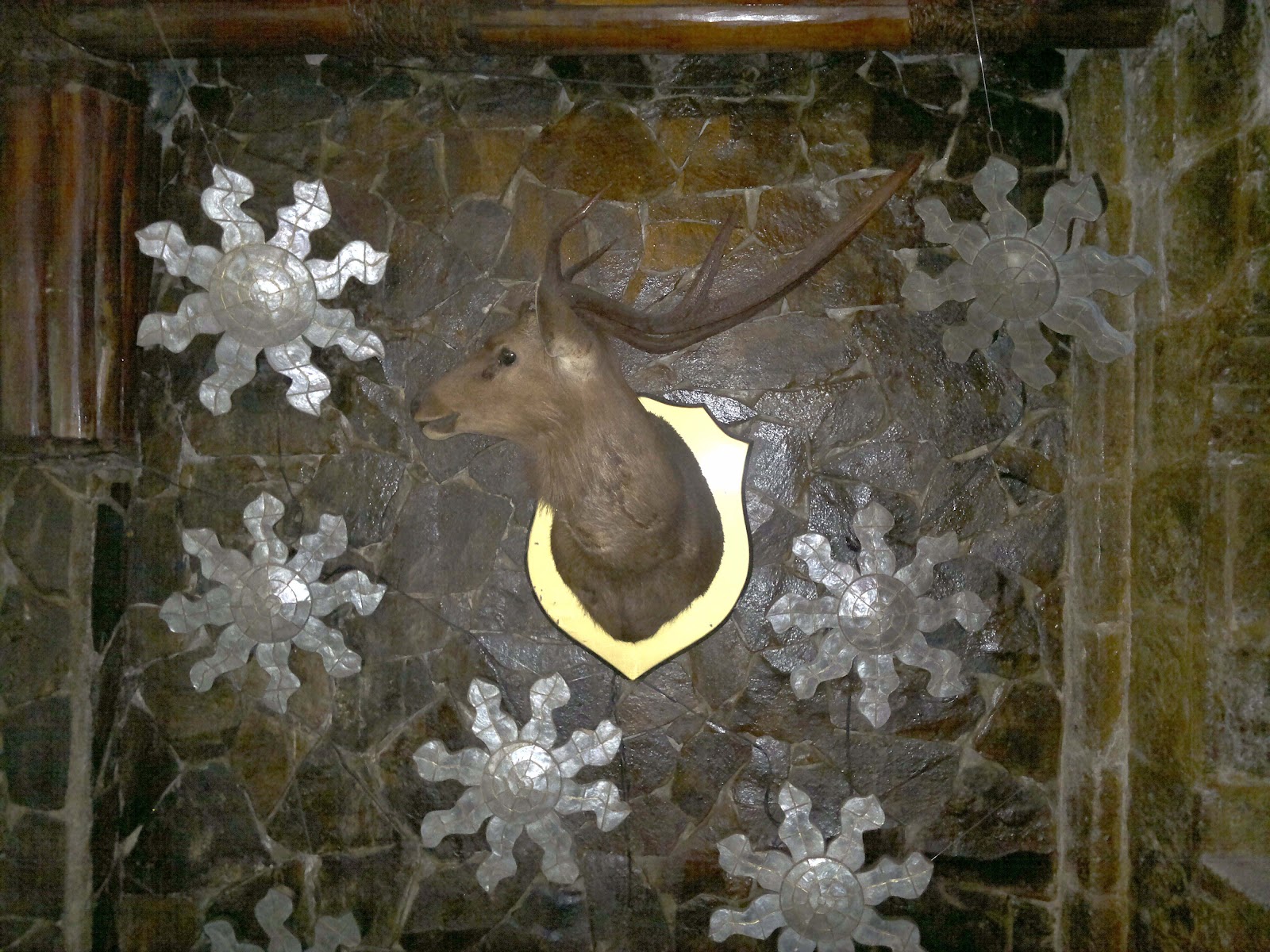
Nakilala ang Exotic Restaurant dahil dito, ang mga customer ay maaaring sumubok ng mga "exotic" na pagkain tulad ng usa, baboy damo, bayawak, sawa at iba pa.
Pero ngayong pinangangalagaan at pinoprotektahan na rin ang mga exotic na hayop, kaunti na lang ang mga palatandaan at bakas na "exotic" ang lugar na ito.
Sa loob ng restaurant, makikita ang mga bayawak na ito na ginawa na lang dekorasyon.

Sa labas naman ng restaurant, meron ding ibong kalaw na ang alam ko ay sa Cagayan Valley natatagpuan.

Sa hardin ng restaurant, meron namang nakataling peacock.

Siguro ay nahuli na ako ng dalaw sa tanyag na kainan at landmark na ito sa Laguna. May ilang parte na ng restaurant na ito ang mukhang abandonado na at hindi na pinapakinabangan.
Pero sana muling mapasigla ng may ari ng lugar na ito ang kanilang restaurant.Sayang din naman ang lugar na ito. Kung wala na silang mga "wild" na pagkain na maisisilbi, pwede rin naman silang magpa uso ng ibang "putahe" gaya ng insekto at maging yong Cuy o guinea pig na sikat na sikat sa mga bansa sa Latin America.
Ewan nga lang kung mas madaling sabihin ang naiisip ko kesa sa gawin.
Magsa ano pa man iyon, All the best sa kainang ito at sana, palayain na lang nila ang mga bilanggong ibon na alaga nila.
Sunday, April 8, 2012
Working on the spiritrual infrastructure to overcome poverty

Karl Marx said that religion is the opiate of the masses because it makes people meekly accept their lot instead of prodding them to question a social order where most of the people are virtual slaves and servants of those who control capital and the means of production.
But what if religion itself becomes the people's tool for strengthening their spiritual infrastructure to defeat poverty?
I am not a bible toting person nor even a very religious one. But my Catholic education has made me familiar with the stories and contents of the bible from which I have drawn some reflections on how people should regard poverty and how to overcome it.
First is the story of creation in the Genesis. Here we are reminded that we are all God's creation but we were given dominion over the other resources God made. No one then has a right to monopolize the resources of this world or universe for himself alone.
Second is the Parable of the Talents. If God created the resources for our sustenance, it is for us God's children to create value and wealth from the resources we were given to sustain us and fill our needs. By so doing, we honor our Creator. It is our responsibility and obligation to work, to be productive to contribute to achieving a wealthy community.
Third is the Parable of the Widow's mite tied up with the story of Judas, feigning concern for the poor and criticizing Mary Magdalene for lavishing Jesus with expensive aromatic oil. In this two stories, we are reminded that true charity comes from giving only of the self, of what we have. It is not charity if we give only what is of others. People who help others with other people's resources are actually working and not engaging in charity. Then there are other people who pretend to be concerned for the poor and disadvantaged by judging how others spend their money without themselves showing the way.
Fourth is a line in the Book of Sirach (not found in non Catholic bibles) that reminds people that it is better to live humbly in one's house than to feast lavishly in another's home. This passage for me points out where to start when trying to help the people - by giving them their own property. This may not be achievable at a personal or individual level but this must be a community or a government effort.
Fifth is the line in the Book of Isaiah about breaking the fetters of injustice so that light can shine into our lives like a new day. Finally, this line tells us that poverty is mostly man made and is the result of an unjust situation. God created all the resources that we need for survival but apathy, ignorance and greed have resulted in a few people living a very privileged existence while a great number were consigned to live a wanting and miserable existence.
Religion and the bible have been used and misused by many for all sorts of reason. I am not sure though if there is something objectionable if the bible will be used to fight poverty.
Just sharing my thoughts.
Happy Easter!
Sunday, April 1, 2012
Tricking tree
Since it is April Fool's Day, I thought of writing about this interesting tree that I saw while biking up the Shotgun trail in San Mateo, Rizal.
From afar, when I looked at this tree, I thought that it was like other trees at that time which was in full flower. But when I went near the tree to see what kind of flower it bears, I realized that what I was looking at were the silvery underside of the leaves of the tree and I certainly was fooled by that tree.

The tree up close.

It is not just people but nature too can play tricks on our eyes as well. Happy April Fools Day.
From afar, when I looked at this tree, I thought that it was like other trees at that time which was in full flower. But when I went near the tree to see what kind of flower it bears, I realized that what I was looking at were the silvery underside of the leaves of the tree and I certainly was fooled by that tree.

The tree up close.

It is not just people but nature too can play tricks on our eyes as well. Happy April Fools Day.
Wednesday, March 28, 2012
Paskong Walang Katapusan

Ilang linggo na lang ay Mahal na Araw na pero para sa restaurant na ito ng isang hotel sa White Beach sa Puerto Galera, pasko pa rin. May balak kaya ang may ari ng restaurant na ito na alisin ang dekorasyon na ito? O permanenteng gayak na ito dito?
Noong huling punta ko sa Puerto Galera maraming taon na ang nakakalipas, hindi pa gaano karami ang mga tao na nagpupunta dito at wala pang malalaking gusali na nakatayo dito. Noon, sapat na ang payak na kapaligiran upang mapahanga ka sa ganda ng lugar. Hindi na kailangan ng palamuti. Ngayon, kahti anong dekorasyon ang ilagay mo sa kapaligiran, hindi nito maikukubli na wala na ang likas na ganda na nagpatanyag sa lugar na ito.
Para sa akin, hindi nakakasaya ang dekorasyong pamasko na nakita ko. Nakakalungkot pa nga.
Friday, March 16, 2012
A refuge in Antipolo
One weekday I found myself in Antipolo with plenty of time and nothing to do. Thinking of where to better spend my time, I decided to go to the Silangan Garden and Pinto Art Museum tucked somewhere in one of the hillside subdivisions in that city.


The place is indeed a pocket of tranquility in a city that is rapidly and wantonly urbanizing. Those looking for some peace and quiet can find refuge here. When I was there, I was fortunate to have a chance to talk with the caretaker/curator(?) in charge of the place and he kindly pointed out to me the value and significance of some of the plants found in the garden.
There is also an art gallery in the grounds of the garden. For me however, the beauty of nature found in the garden is enough reason for my visit.


The place is indeed a pocket of tranquility in a city that is rapidly and wantonly urbanizing. Those looking for some peace and quiet can find refuge here. When I was there, I was fortunate to have a chance to talk with the caretaker/curator(?) in charge of the place and he kindly pointed out to me the value and significance of some of the plants found in the garden.
There is also an art gallery in the grounds of the garden. For me however, the beauty of nature found in the garden is enough reason for my visit.
Wednesday, March 7, 2012
Wasting a precious resource
 The town of Lucban, Quezon is known for its Pahiyas Festival, longganisa and its pilgrimage Healing Church named Kamay ni Hesus.
However, what I find most interesting there is its water resource which simply drains through the canal. I feel very sad that this water is not being tapped and utilized in a more productive way.
Running water is a specially precious resource that does not only nourish plants and quenches thirst. Running water is a potential source of energy that can help generate wealth for those who know how to tap its power.
I am not just talking about hydro-electric power which would require a bigger amount of water and capital. What I am thinking of are simple water mills that can provide mechanical energy for small scale use. For instance water energy can run mills that can grind rice, corn, rootcrops and turn them into flour. It can pound tough fibers to make special paper. Instead of just letting the water drain through the canals, water engineers can perhaps make gravity fountains to make the town more beautiful and interesting etc.
In Europe, watermills played a great role in fostering the Industrial Revolution by boosting productivity and allowing societies to create surplus.
In the Philippines, we still have to learn how to utilize our resources more efficiently instead of just letting it go down the drain... err canal.
Saturday, March 3, 2012
Concertina Wire Country

In our minds, we Filipinos like to believe that we are a friendly and hospitable people capable of great things and achievements.
But what does it tell about us when just by looking around, we see that barbed wires are a common sight used to protect property and even just the plants along the sidewalks?
What kind of people are we or what kind of society do we have that we have accepted the unfriendly and hostile sight of barbed wires as a normal part of our environment?
Barbed wires in the city give an impression that we are a people living under occupation. But then if we think about the great and still growing disparity of wealth between the mass of people who are poor in our country and the few rich who own virtually the entire country if not its best parts, we could well be living in a virtual occupation regime of elites who impose a system of unjust social order on us.
At any rate, barbed wires remind us of a negligent government incapable of creating a kind and gentle city or maybe a people who have come to accept social inequity as a way of life... until maybe their seething resentment reaches a critical mass. And then they explode.

Monday, February 27, 2012
PNoy is Naked!

Although I support President Noynoy Aquino especially in his determined drive to hold accountable those who pillaged and caused injury to our country, there are some things which I hope he will take a second look at because they only make him like the emperor who walked around in a supposedly magic new clothes.
First is his campaign slogan "Kung walang corrupt, walang mahirap". While this may have struck a chord with the voting public, this is an erroneous thinking that does not do much to solve neither corruption nor poverty.
Corruption may exacerbate the effects of poverty but it is not poverty's main creating mechanism. Poverty is the absence of wealth and there are two reasons how this can be so. One is that the capacity of people, for whatever reason, to generate wealth is low. The other is that the wealth that people generate is unjustly denied or inequitably shared among them. By harping on the notion that corruption causes poverty - and not for other reasons like low productivity, ignorance, contractualization, capital flight etc., the President fails to squarely face the problem of poverty and do something concrete about it.
On the other hand, the President's idea of fighting corruption is limited to procedural tightening and running after those who have committed such a crime. Again, while this effort is laudable, it does not look into the roots of corruption which is the mentality of rent and entitlement. This mentality is so deeply rooted and so widespread that it afflicts almost all Filipinos. Those who are afflicted with the rent and entitlement mentality have no understanding of how wealth is made and have a shaky moral foundation with regards to obtaining money.
Second item that I hope the President reconsiders is his campaign promise of "transformational change". For me this phrase is bull. By itself, change alone, for as long as it is positive is already enough. Why try to sound more profound with a redundancy? I hope the President realizes that those who foisted to him this phrase are merely performing verbal shamanism on him and taking him for a ride. What can these people really achieve that can not simply be called change? But of course they get to hold good jobs and a Rasputinian influence.
Last item that I hope that the President will revisit is the claim he once made that our Department of Science and Technology had virtually conquered dengue with their mosquito ovitrap invention. While he was made to make glowing claims about this in several public occasions, I have talked to some people in places where this device was tried and who said that they could not really tell if they work. Proof that the claim may be hollow is that the use of these contraption have not become widespread. The DOST is one government agency that really needs to be changed ... or transformed.
I do not know if the President will see things my way, but from where I stand, looking at the President's three "robes", I can see that he is naked.
Subscribe to:
Posts (Atom)
